
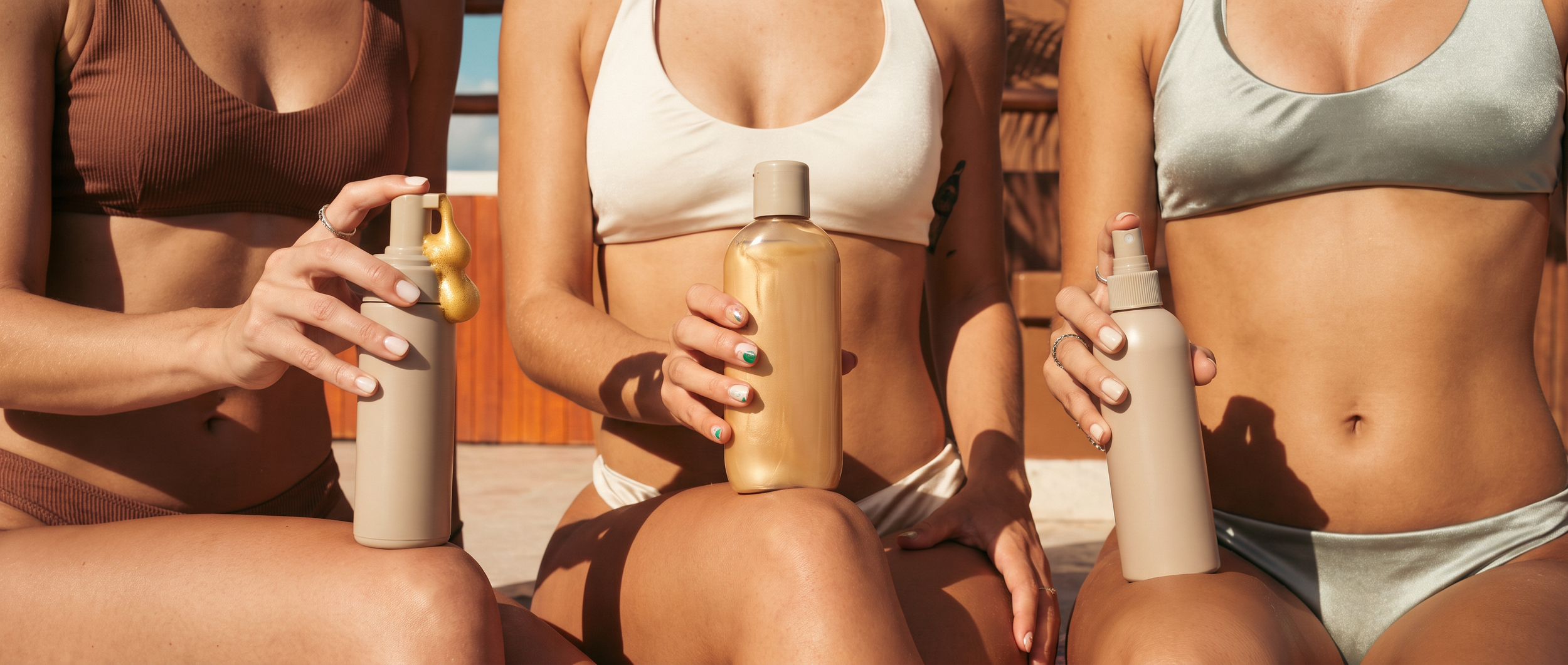
Everything You Need to Know About Building Your Sunless Tanning Brand
01 | Getting Started
-
Starting a self-tanning brand involves identifying your target customer, selecting a product format, determining your product's competitive advantage, establishing a budget, securing a formulation and manufacturing partner, and developing your packaging and branding.
Beach Babe Labs is a US-based cosmetic formulation and contract manufacturing company specializing in sunless tanning products. We work with entrepreneurs and established beauty brands to develop custom self-tanning formulations and bring them into commercial production.
You do not need previous cosmetic manufacturing experience or an existing formulation to get started.
-
Beach Babe Labs specializes in American-made sunless tanning product development and contract manufacturing for emerging and established beauty brands.
Our capabilities include custom self-tanning mousses, tanning lotions, gradual tanners, tanning drops, facial tanning mists, professional spray tanning solutions, tan extenders, and skincare-infused tanning products.
Unlike general cosmetic manufacturers that offer self-tanning as one of many product categories, sunless tanning is our specialty.
-
The cost of launching a self-tanning brand depends on your product format, formulation requirements, packaging, initial manufacturing quantity, branding, distribution strategy, and marketing budget.
At Beach Babe Labs, our standard custom formulation development program begins at $1,000, with commercial manufacturing minimums starting at 1,000 units.
Your total investment will depend on the specific product you choose to develop. We encourage clients to consider their target retail price, anticipated profit margins, and future manufacturing volumes when planning their initial launch.
-
Beach Babe Labs offers custom self-tanning manufacturing with minimum order quantities starting at 1,000 units.
This allows emerging beauty brands to access custom formulation and American manufacturing without immediately committing to large-scale production.
We also support established brands seeking larger manufacturing volumes and more competitive unit economics as their businesses grow.
-
Yes. Beach Babe Labs specializes in developing custom self-tanning formulations around your brand's individual objectives rather than limiting you to a selection of existing stock formulas.
Customization can include tanning intensity, DHA and erythrulose concentrations, undertones, texture, fragrance, skincare ingredients, application experience, drying time, skin feel, and ingredient preferences.
Our goal is to develop a product that gives consumers a meaningful reason to choose your brand.
-
Private label self-tanning typically involves purchasing an existing formulation and selling it under your own brand. It can provide a relatively straightforward entry into the market, but opportunities for product differentiation may be limited.
Custom self-tanning formulation involves developing a product around your brand's specific performance objectives, ingredient preferences, and desired consumer experience.
Beach Babe Labs specializes in custom formulation and contract manufacturing for brands that want to distinguish themselves through product innovation rather than branding alone.
-
Initial custom formulation samples are typically prepared within approximately three to four weeks after your project begins, depending on formulation complexity and raw material availability.
Our standard development program allows for up to six formulation revisions or six months of development, whichever comes first.
Commercial manufacturing follows formulation approval and is a separate stage of the process.
We recommend beginning development well in advance of your intended launch, allowing time for sample evaluations, packaging sourcing, and production planning.
-
The best product to launch depends on your target audience, brand positioning, budget, and intended sales channels.
Self-tanning mousses are popular for traditional full-body tanning, while facial tanning mists and tanning drops appeal to consumers interested in incorporating sunless tanning into their skincare routines. Gradual tanning lotions appeal to consumers seeking a more subtle, buildable tanning experience.
We generally encourage new brands to consider launching with one exceptional hero product before expanding into a larger collection.
-
Successful product differentiation goes beyond selecting attractive packaging, adding a trending ingredient, or creating a new fragrance.
Consumers may be looking for a self-tanner that dries faster, feels less sticky, develops a more natural-looking color, fades more evenly, incorporates meaningful skincare benefits, or offers a more convenient application experience.
Our approach to custom formulation begins by understanding what your target consumer wants and identifying opportunities to create a better product experience.
-
What should I look for when choosing a self-tanning manufacturer?
When selecting a self-tanning manufacturer, consider their experience with sunless tanning chemistry, custom formulation capabilities, manufacturing minimums, product development process, and ability to support your brand as it grows.
Self-tanning products have unique technical requirements that differ from conventional skincare products. Tanning active handling, ingredient compatibility, formulation pH, and manufacturing conditions can all influence finished product performance.
Choosing a partner with specialized sunless tanning experience can be particularly valuable when developing innovative or highly differentiated products.
-
Yes. We work with entrepreneurs, professional spray tan artists, influencers, salon owners, beauty industry professionals, and established cosmetic brands.
You do not need to understand cosmetic chemistry, ingredient percentages, manufacturing procedures, or formulation science before contacting us.
You bring your understanding of your customer and your brand vision. We bring the technical expertise required to develop your product.
-
Can you develop a self-tanning product based on a product I already love?
Yes. Competitive benchmark products are an excellent starting point for custom formulation.
You may love the tanning color of one product, the texture of another, and the application experience of a third. You may also have an existing favorite that you wish performed better.
Providing physical product samples and detailed feedback helps us understand your preferences and establish clear formulation objectives.
-
Yes. Beach Babe Labs works with established brands seeking to improve existing formulations, introduce new product formats, modernize ingredient lists, optimize manufacturing costs, or transition to American manufacturing.
Whether you are experiencing limitations with your current product or looking to develop your next sunless tanning innovation, we can evaluate opportunities to improve your product offering.
-
No. Product development, branding, and packaging sourcing can take place concurrently.
However, we encourage clients to begin exploring packaging options early because packaging can directly influence formulation design. This is particularly important for self-tanning mousses, fine mists, and tanning drops, where dispensing performance is part of the overall consumer experience.
-
No. You can provide ingredient preferences, desired skincare benefits, marketing objectives, certifications you are pursuing, or ingredients you wish to exclude.
Our cosmetic chemistry expertise allows us to evaluate which ingredients are appropriate for your specific formulation.
Not every popular skincare ingredient is compatible with tanning actives, which is why specialized formulation experience is particularly valuable when developing sunless tanning products.
-
The most helpful information includes your desired product format, target customer, competitive benchmark products, preferred tanning intensity, desired product benefits, anticipated manufacturing quantity, packaging plans, and target investment budget.
You do not need to have every detail finalized. Our project inquiry form is designed to help identify the most important aspects of your product concept and determine the appropriate development pathway.
-
Yes. We work with brands at different stages of growth, from first-time entrepreneurs developing their initial hero product to established beauty businesses expanding or improving their sunless tanning collections.
Our custom formulation and manufacturing model is designed to support product innovation, initial commercial launches, and long-term brand growth.
-
We selectively accept projects based on our specialized expertise, development capacity, manufacturing capabilities, and alignment with the client's commercial objectives.
We are particularly interested in working with brands that value product differentiation, innovation, quality, and long-term manufacturing relationships.
-
Yes. Our Self-Tan Start-Up Guide is designed to help entrepreneurs understand the fundamentals of sunless tanning product development and manufacturing.
The guide covers tanning actives, product formats, tanning intensity, guide colors, fragrance considerations, ingredient selection, packaging, and important commercial considerations when developing a self-tanning brand.
We recommend reviewing the guide before beginning your first custom formulation project.
-
Begin by completing our project inquiry form and telling us about the product you want to create.
Our team will review your concept, formulation objectives, and anticipated manufacturing requirements to determine whether your project aligns with our capabilities.
Once your project has been accepted and your development fee has been received, we can begin the custom formulation process.
Your next sunless tanning innovation starts here.
02 | Science
-
Dihydroxyacetone (DHA) and erythrulose are two ingredients used to produce a developed sunless tan. DHA is the primary tanning ingredient in most commercial self-tanning products.
These ingredients react with amino groups in the outermost layer of the skin through a nonenzymatic browning reaction commonly associated with Maillard chemistry. This produces temporary brown coloration without requiring UV exposure or stimulating melanin production.
Other ingredients in a self-tanning formulation influence application, hydration, drying time, stability, fragrance, texture, and the overall consumer experience.
-
DHA and erythrulose are chemically distinct sugars that produce temporary coloration through reactions with components of the outermost layer of the skin.
DHA generally develops color more quickly, while erythrulose typically has a slower color development profile. Combining these ingredients can provide additional flexibility when designing the tanning intensity, color development timeline, and overall tanning experience.
Erythrulose is generally more expensive than DHA, making the selection and ratio of these ingredients important considerations in commercial product development.
-
There is no universal ideal DHA concentration. The appropriate percentage depends on the product format, desired tanning intensity, application method, recommended wear time, target consumer, and regulatory requirements of the intended market.
A gradual tanning lotion, facial tanning mist, professional spray tanning solution, and ultra-dark tanning mousse may all require significantly different tanning active concentrations.
At Beach Babe Labs, we develop around the desired consumer experience rather than selecting a DHA percentage based solely on marketing trends.
-
Not necessarily. Higher DHA concentrations can produce deeper coloration under comparable application conditions, but they can also introduce additional formulation challenges.
Increasing DHA can affect tackiness, developing odor, product stability, color uniformity, and application characteristics.
The overall formulation, application quantity, wear time, and individual skin chemistry are equally important considerations. A well-developed formulation with a lower DHA concentration may provide a more desirable consumer experience than a poorly optimized formulation containing more DHA.
-
We can explore alternative tanning technologies, including erythrulose-based formulations, subject to ingredient suitability and regulatory requirements.
However, DHA-free products may have different color development timelines, performance characteristics, ingredient costs, and formulation limitations compared with conventional DHA-based products.
It is important to distinguish between temporary cosmetic bronzing products and products that produce a developed sunless tan.
-
A cosmetic bronzer deposits temporary color onto the skin, providing an immediate visible effect. This color is generally removed through washing or cleansing.
A self-tanner produces temporary coloration within the outermost layer of the skin through the reaction of tanning ingredients such as DHA.
Some self-tanning products contain both cosmetic guide colorants and tanning actives, providing immediate color during application followed by a developed tan.
-
Guide color is the immediate visible color provided by cosmetic dyes, pigments, or other suitable colorants incorporated into a self-tanning formulation.
It helps consumers see where the product has been applied and can provide an immediate bronzing effect while the tanning actives begin developing.
Guide color is not the developed tan. It typically washes away during the initial rinse, while the developed coloration remains and may continue developing afterward.
-
Yes. We can develop different guide color profiles, including golden, neutral brown, olive, violet, red-brown, and other color combinations, subject to ingredient availability and applicable color additive regulations.
Guide color development requires consideration of colorant compatibility, product stability, staining potential, packaging, and the intended application experience.
The appearance of a self-tanning product in its packaging does not necessarily represent the color it will produce on the skin.
-
These descriptions generally refer to the guide color system incorporated into a self-tanning formulation.
Different combinations of cosmetic colorants can influence the immediate appearance of the product and help create a particular visual experience during application.
However, the developed tan is primarily influenced by tanning actives, formulation characteristics, application conditions, and individual skin chemistry.
A violet or green guide color does not automatically guarantee a particular developed undertone after rinsing.
-
Creating a natural-looking developed tan is one of the most common objectives in sunless tanning formulation.
We evaluate tanning active concentrations, ingredient combinations, application characteristics, and color development to optimize the overall tanning experience.
However, developed tanning color varies between individuals. Skin chemistry, skin condition, application quantity, and wear time can all influence the final result.
No formulation can guarantee an identical developed color across every skin type and skin tone.
-
Yes. We can develop self-tanning products without added synthetic guide colorants or without added guide color altogether.
Natural-origin colorants may also be explored, although they can introduce challenges related to color consistency, stability, staining, odor, and ingredient compatibility.
Color additive regulations vary by market and intended application. We evaluate colorant options based on both formulation performance and the regulatory requirements of the intended market.
-
Self-tanning formulations contain chemically reactive ingredients. Changes in temperature, pH, ingredient interactions, oxidation, light exposure, and storage conditions can influence the appearance of the product over time.
Guide colorants can also change at different rates, potentially altering the visible color of the formulation.
A change in product color does not automatically indicate that the tanning actives are no longer effective. However, unexpected discoloration should be evaluated as part of product stability and quality assessment.
-
We can develop self-tanning formulations without added guide colorants, which can help reduce immediate color transfer associated with traditional tinted products.
However, clear tanning products still contain reactive tanning ingredients. Contact with fabrics and other materials may result in discoloration under certain conditions.
Claims such as transfer-free, stain-free, or non-staining require appropriate testing and substantiation.
-
Express self-tanning products are designed around shorter recommended wear times before rinsing, while traditional self-tanning products generally remain on the skin for longer periods before rinsing.
Express formulations often require different tanning active concentrations and formulation strategies to achieve the desired performance.
Rinsing an express self-tanner does not necessarily stop the tanning reaction immediately. Color development can continue for several hours after the initial rinse.
-
Express tanning products often require higher concentrations of tanning actives or more specialized formulation strategies to achieve the desired performance within a shorter application window.
Tanning actives represent a significant portion of the raw material cost in many sunless tanning formulations.
Higher active concentrations can also introduce additional challenges related to stability, tackiness, fragrance compatibility, and sensory performance, requiring more careful formulation optimization.
-
We can explore formulations designed around shorter recommended application and rinse times.
However, it is important to distinguish between the recommended wear time before rinsing and the time required for the tan to fully develop.
A product marketed as a one-hour express tan may be designed to rinse after one hour, while the developed color continues to deepen afterward.
Specific timing and performance claims must be supported by appropriate product testing.
-
Tanning actives such as DHA and erythrulose can contribute to tackiness, particularly at higher concentrations.
Humectants, film-forming ingredients, solvents, emollients, application quantity, and environmental conditions can also influence how a self-tanning product feels on the skin.
Reducing tackiness requires careful formulation design rather than simply removing one ingredient. We work to balance tanning intensity, hydration, drying time, application playtime, and overall sensory performance.
-
Yes. Fast-drying, alcohol-free formulations can be explored through ingredient selection and optimization of the formulation system.
However, removing volatile alcohols may influence drying time, application characteristics, ingredient solubility, and sensory performance.
The appropriate approach depends on the product format, tanning active concentration, packaging, and desired consumer experience.
-
The characteristic developing odor associated with self-tanning products is largely related to chemical reactions occurring between tanning actives and components of the skin.
This is different from the fragrance of the product when it is first applied.
We can work to minimize undesirable odors through formulation optimization, fragrance selection, and ingredient compatibility. However, completely eliminating developing odor across every consumer and application condition cannot be guaranteed.
-
Yes. Even fading is an important performance objective in sunless tanning development.
Formulation characteristics, application uniformity, skin hydration, and tanning intensity can influence how a developed tan wears over time.
However, natural skin exfoliation rates, skin preparation, bathing habits, friction, and individual skin conditions also influence fading.
We evaluate fading as part of the overall consumer experience rather than focusing exclusively on initial color development.
-
Yes. Skincare-infused self-tanning products are an important area of innovation within the sunless tanning category.
Potential ingredients include hyaluronic acid, glycerin, ceramides, botanical extracts, emollients, antioxidants, and other skin-conditioning ingredients.
However, not every skincare ingredient is compatible with tanning actives. Ingredient selection must account for chemical compatibility, pH requirements, stability, preservation, and meaningful cosmetic benefits.
Adding a popular skincare ingredient does not automatically improve the performance of a self-tanning formulation.
-
These ingredients require particular consideration in sunless tanning formulations.
DHA is reactive with amino groups, meaning certain peptides, amino acids, proteins, and related raw materials may contribute to unwanted browning, odor changes, or other stability issues within the formulation.
We evaluate these ingredients individually rather than assuming they will perform the same way they would in a conventional skincare product.
-
Yes. We can explore formulations around naturally derived ingredients, organic ingredient preferences, clean beauty standards, and brand-specific ingredient restrictions.
However, natural, naturally derived, organic, and clean are not interchangeable terms.
A formulation containing organic ingredients is not necessarily a certified organic finished product. Certification requirements must be considered separately and may influence ingredient sourcing, formulation architecture, manufacturing, and documentation.
We recommend establishing the specific standard your brand wishes to meet before development begins.
-
Yes. We can develop self-tanning formulations around vegan ingredient requirements.
Ingredient origin must be evaluated at the raw material and supplier level, as an ingredient's INCI name alone does not always disclose its source.
Any third-party vegan certification requirements should be communicated at the beginning of development.
-
Yes. We can work with defined ingredient exclusion lists and brand-specific formulation standards.
However, ingredient restrictions can affect preservation, sensory performance, stability, manufacturing cost, and the range of available formulation technologies.
We help clients understand these trade-offs and identify appropriate alternatives without unnecessarily compromising product quality or performance.
-
Tanning active stability is strongly influenced by pH.
DHA is generally more stable under appropriately acidic formulation conditions. However, the ideal pH must also account for skin compatibility, preservation, ingredient interactions, and the overall formulation system.
Many ingredients used in conventional skincare require different pH conditions, which can make incorporating them into self-tanning products more challenging.
-
DHA is a specialty cosmetic ingredient that requires appropriate storage, handling, and processing conditions.
Excessive heat and unsuitable storage conditions can contribute to degradation, discoloration, and other unwanted changes.
Temperature management is important throughout the supply chain, from raw material storage through manufacturing and finished product distribution.
Specialized manufacturing experience helps reduce unnecessary exposure to conditions that may compromise tanning active stability.
-
Most water-containing self-tanning formulations require an effective preservation strategy to protect against microbial contamination during storage and consumer use.
Preservative selection must account for the formulation's pH, ingredient compatibility, packaging, intended use, and applicable regulatory requirements.
A preservative system that performs well in a traditional skincare product may not necessarily be appropriate for a self-tanning formulation.
Preservation effectiveness should be established through appropriate testing.
-
We can develop formulations around sensitive-skin positioning, including fragrance-free options, carefully selected ingredients, and simplified formulation approaches.
However, individual skin responses vary, and no cosmetic product can guarantee that irritation or sensitivity will never occur.
Claims such as suitable for sensitive skin, hypoallergenic, or dermatologist tested require appropriate substantiation.
-
Facial and body self-tanning products may have different formulation requirements based on application area, desired tanning intensity, skin feel, ingredient preferences, and dispensing method.
Facial products are often developed around lightweight textures, controlled color development, compatibility with skincare routines, and precise application.
Body products may prioritize larger-area application, spreadability, drying time, guide color, and more intensive tanning performance.
We develop each product around its intended application rather than assuming one formulation is suitable for every use.
-
No. A developed sunless tan does not provide reliable protection against ultraviolet radiation.
Self-tanning products should not be marketed as providing SPF or sun protection unless they meet the applicable regulatory requirements for sunscreen products.
Consumers should continue using appropriate sun protection regardless of whether they have applied a self-tanning product.
-
Sunless tanning is one of the more chemically demanding categories within cosmetic formulation.
Tanning actives are reactive ingredients that must coexist with preservatives, fragrances, colorants, botanical extracts, emulsifiers, surfactants, and other cosmetic raw materials while maintaining appropriate stability and performance.
A seemingly minor ingredient substitution can influence color development, product appearance, viscosity, fragrance, preservation, or shelf life.
At Beach Babe Labs, understanding these interactions is fundamental to our development process. Our objective is to create products that perform not only when they are first formulated, but throughout their intended commercial lifecycle.
03 | Custom Development
-
Starting a self-tanning brand begins with identifying your target customer, product format, desired tanning performance, brand positioning, and initial manufacturing budget.
You do not need to have a finalized ingredient list or understand cosmetic chemistry before contacting us. Our development team can help translate your product vision into a technically feasible formulation.
We recommend downloading our Self-Tan Start-Up Guide before beginning your development journey.
-
Our custom formulation program for qualifying manufacturing clients begins with a $1,000 development fee per formulation.
This fee secures your position in our formulation queue and provides access to our specialized cosmetic chemistry expertise, ingredient research, prototype development, sampling, and formulation refinement.
Manufacturing, packaging, specialized testing, and additional development services are quoted separately.
-
Private-label products typically use an existing formulation that may be sold to multiple brands under different labels. While this can provide a faster entry into the market, it offers limited opportunities for meaningful product differentiation.
Custom formulation allows you to develop a product around your own performance objectives, ingredient preferences, tanning intensity, fragrance, texture, packaging, and brand positioning.
For brands looking to establish a competitive advantage and build long-term customer loyalty, custom formulation offers significantly greater flexibility.
-
Yes. Our custom development program is designed around your individual product brief rather than simply selecting a formula from a catalog.
We work with you to establish the characteristics that make your product distinctive, whether that involves its ingredient list, tanning performance, application experience, fragrance, texture, or skincare benefits.
Formula ownership and exclusivity are governed by your development agreement.
-
Yes. Depending on your objectives, we may be able to use an established formulation architecture as a starting point and customize it to meet your brand's requirements.
This can be an efficient development pathway when you are looking to modify tanning intensity, sensory characteristics, fragrance, ingredient selection, or other product attributes without developing an entirely new formulation system.
-
The more information you can provide, the more efficiently we can develop your product.
Helpful information includes:
Desired product format
Target customer and retail positioning
Competitive benchmark products
Desired tanning intensity
Preferred guide color or clear formulation
Desired application and sensory experience
Ingredients you want to include or avoid
Fragrance preferences
Target fill size
Intended packaging
Target manufacturing cost per unit
Anticipated initial order quantity
Countries where you intend to sell your product
You do not need to have every answer before contacting us. We can help you identify and prioritize these decisions.
-
No. Ingredient selection is part of our formulation expertise.
Some clients approach us with detailed ingredient requirements, while others simply describe the product experience they want to create.
We can recommend ingredients based on your desired performance, brand philosophy, target price point, and marketing objectives. We will also explain when certain ingredients may create technical challenges or offer limited value in a sunless tanning formulation.
-
Yes. An ingredient list can provide valuable insight into your desired formulation architecture and product positioning.
However, a cosmetic ingredient declaration does not disclose exact ingredient percentages, raw material grades, supplier technologies, processing methods, or manufacturing procedures.
Our formulation team uses this information alongside product evaluation and cosmetic chemistry expertise to develop a technically appropriate formulation.
-
We generally aim to provide initial samples within three to four weeks after your development project has commenced, subject to ingredient availability and project complexity.
Our goal is to achieve an approved formulation within as few development rounds as possible. Some products may be approved quickly, while more complex innovations may require additional research and refinement.
Sample approval, formal testing, packaging procurement, and commercial manufacturing are separate milestones that influence your overall launch timeline.
-
Our standard custom development program includes up to six formulation revisions or six months of development, whichever occurs first.
Not every project requires six revisions. Our objective is to develop an approved formulation efficiently while giving you the opportunity to evaluate and refine your product.
Significant changes to the original product brief or additional development beyond the agreed scope may require additional fees.
-
The first sample is a starting point, not necessarily the finished product.
Custom formulation is an iterative process. Your feedback helps us understand which characteristics are working and which require further refinement.
For example, you may love the developed color but want a lighter texture, faster drying time, less tackiness, or a different fragrance. We use this feedback to guide subsequent formulation adjustments.
-
We recommend evaluating samples under consistent application conditions and comparing them with your benchmark products whenever possible.
Important characteristics to evaluate include:
Ease of application and spreadability
Guide color and immediate appearance
Drying time
Tackiness and skin feel
Fragrance during application
Odor during color development
Developed tanning intensity
Developed color and undertone
Evenness of application
Transfer to clothing or bedding
Longevity and fading
Packaging and dispensing performance
It is equally important to communicate what you like about a sample so those characteristics can be preserved during subsequent revisions.
-
We can work toward these objectives, but formulation development often involves balancing competing performance characteristics.
Higher tanning active concentrations, for example, can contribute to increased tackiness. Changes intended to improve drying time may influence application playtime, spreadability, or skin feel.
Our role is to help you understand these relationships and determine which performance characteristics are most important to your target consumer.
The best formulation is not necessarily the one with the highest concentration of tanning actives. It is the one that delivers the best overall experience for your intended customer.
-
Yes. Premium sunless tanning development extends beyond simply adding expensive ingredients.
We consider application elegance, texture, fragrance, drying characteristics, developed color, fading, packaging performance, ingredient differentiation, and the overall consumer experience.
We can also explore specialty skincare ingredients and innovative formulation technologies that support your premium brand positioning.
-
Yes. We can develop around a target manufacturing cost, provided the budget is realistic for the desired performance, product format, fill size, and anticipated production volume.
Communicating your target cost early allows us to make informed decisions about formulation architecture, ingredient selection, and manufacturing efficiencies.
It is important to distinguish your target manufacturing cost from your intended retail selling price.
-
We can discuss preliminary manufacturing cost expectations based on your product format, fill size, tanning intensity, anticipated ingredients, and production volume.
However, final manufacturing pricing depends on the approved formulation and commercial production requirements.
Two self-tanning mousses of the same size can have significantly different manufacturing costs based on their tanning active concentrations, specialty ingredients, fragrance, and formulation architecture.
-
No. Our custom development program allows you to evaluate and refine your formulation before moving into commercial manufacturing.
However, our development program is intended for brands with a genuine intention to manufacture. Our standard custom manufacturing minimum begins at 1,000 units per formulation or SKU.
Brands seeking formulation development without a manufacturing commitment may explore our independent formulation ownership services.
-
Yes. We offer a separate independent formulation development pathway for clients who wish to own their formulation and have the flexibility to select their own manufacturing partner.
Independent formulation development generally ranges from $15,000 to $20,000 per formulation, depending on complexity and technical requirements.
This is different from our $1,000 custom development program, which is structured around an ongoing manufacturing relationship with Beach Babe Labs.
-
Yes. Our custom manufacturing program offers a pathway to formula ownership after 100,000 cumulative qualifying units have been manufactured through Beach Babe Labs, subject to the terms of your agreement.
This allows emerging brands to access specialized custom formulation expertise without the substantial upfront investment typically associated with independent formula ownership.
-
We strongly recommend beginning your packaging search early in the development process.
The intended packaging can influence formulation viscosity, dispensing performance, product stability, and the overall consumer experience.
This is particularly important for self-tanning mousses, where the foaming pump is an integral part of product performance. We develop and evaluate the formulation using samples of your intended packaging whenever possible.
-
Yes. We can develop a coordinated formulation system with multiple tanning intensities, such as light, medium, dark, and ultra-dark.
However, increasing or decreasing tanning active concentrations is not always as simple as changing a percentage. Each variation may require adjustments to maintain appropriate texture, stability, fragrance, and application performance.
Each commercial variation must be appropriately evaluated before manufacturing.
-
Absolutely. Many successful brands begin with a single hero product before expanding into additional formats or tanning intensities.
Starting with one product can help you manage your initial investment, establish consumer demand, collect feedback, and better understand your market before expanding your collection.
We can approach your initial formulation with your long-term product development strategy in mind.
-
No. We intentionally limit the number of new development projects we accept so that we can dedicate appropriate technical attention to each client.
Projects are evaluated based on formulation feasibility, manufacturing requirements, commercial objectives, development capacity, and alignment with our specialized capabilities.
We encourage prospective clients to submit a detailed manufacturing inquiry so we can determine whether Beach Babe Labs is the right development partner for their brand.
04 | Fragrance, Packaging & Product Compatibility
-
Yes. Fragrance is an important part of your brand identity and the overall consumer experience. Clients may source their own fragrance or select from a limited range of fragrance options available through Beach Babe Labs.
However, not all fragrances are compatible with sunless tanning formulations. Fragrances must be evaluated for chemical compatibility, solubility, discoloration, odor changes, stability, and suitability for the intended product application.
We recommend establishing your fragrance direction early in the development process.
-
Yes. You are welcome to work directly with a fragrance supplier and provide fragrance samples for our evaluation.
Your fragrance supplier should be able to provide the appropriate technical and regulatory documentation, including an IFRA Certificate of Conformity for the intended product application, safety data sheet, and applicable fragrance allergen information.
We recommend communicating to your fragrance supplier that the fragrance will be incorporated into a product containing DHA and potentially erythrulose.
-
Can Beach Babe Labs develop a custom signature fragrance for my brand?
Yes. For brands seeking a distinctive signature fragrance, we can assist with custom fragrance development as a separate project beginning at $5,000.
Custom fragrance development allows you to explore a fragrance identity that complements your brand positioning, target consumer, and product collection.
The fragrance must also be evaluated for compatibility with your sunless tanning formulation. Custom fragrance development is separate from our standard $1,000 custom formulation program.
-
Sunless tanning formulations present unique challenges because of the chemical reactivity of tanning actives and the acidic conditions typically required for their stability.
Certain fragrance components may contribute to discoloration, undesirable odor changes, reduced stability, or changes in the physical characteristics of the formulation.
A fragrance that performs beautifully in a traditional body lotion may not perform the same way in a self-tanning lotion or mousse.
Fragrance compatibility is one of the many reasons specialized sunless tanning formulation experience matters.
-
Essential oils may be considered during formulation development, but natural fragrance ingredients are not automatically more compatible, more stable, or less irritating than synthetic fragrance ingredients.
Essential oils contain complex mixtures of naturally occurring compounds that may interact with tanning actives or other formulation ingredients. Some also have specific usage restrictions or phototoxicity considerations.
We evaluate fragrance materials individually based on their suitability for the intended product.
-
Yes. We can develop fragrance-free self-tanning mousses, lotions, drops, mists, serums, and other product formats.
Fragrance-free does not necessarily mean odorless. Tanning actives and other cosmetic raw materials may have naturally occurring odors, and a characteristic tanning odor may develop as the product reacts with the skin.
-
Yes. We can develop a coordinated product collection featuring different fragrance options.
However, each fragrance variation must be evaluated individually. Changing a fragrance can influence product viscosity, clarity, color, foam performance, preservation, and stability.
Additional fragrance variations may require separate development, testing, and manufacturing minimums.
-
Potentially. A consistent signature fragrance can help establish a recognizable brand identity across multiple products.
However, a fragrance may behave differently in a mousse, lotion, mist, or concentrated tanning drop. Fragrance concentration, solubility, and compatibility may need to be adjusted for each product format.
We evaluate each formulation individually while working toward a cohesive fragrance experience.
-
Item deClients are responsible for sourcing and purchasing their own packaging components, including bottles, tubes, jars, pumps, closures, labels, cartons, and other branded packaging materials.
This gives you greater control over your brand aesthetic, packaging quality, supplier relationships, and packaging costs.
Beach Babe Labs provides formulation-related technical guidance to help ensure your selected packaging is suitable for your product.scription
-
We can provide guidance on appropriate packaging types, dispensing systems, and technical considerations for your intended product.
Clients are responsible for establishing their own supplier relationships, requesting samples, obtaining quotations, approving packaging specifications, and placing packaging orders.
We strongly recommend evaluating physical packaging samples before committing to a commercial packaging purchase.
-
Packaging sourcing should begin at the start of your product development project, not after your formula has been approved.
Packaging suppliers may have minimum order quantities, customization requirements, tooling costs, decoration lead times, and extended shipping timelines.
Beginning this process early allows packaging development and formulation development to progress together, reducing the risk of unnecessary delays.
-
Yes. Physical samples of your intended packaging are an important part of the formulation development process.
We need to understand how your product will be stored, dispensed, and applied before finalizing the formulation.
For products such as self-tanning mousses, facial mists, tanning drops, and spray tanning solutions, the dispensing system can directly influence the formulation requirements and consumer experience.
-
Self-tanning mousses typically require a non-aerosol foaming pump and a compatible bottle.
Not all foaming pumps perform the same way. Pump design, mesh configuration, air-to-liquid ratio, dispensing volume, and internal component materials can influence the quality and consistency of the foam.
We recommend selecting your intended foaming pump early and providing physical samples during formulation development.
-
A self-tanning mousse is generally a liquid formulation that is converted into foam as it passes through a specialized foaming pump.
The mousse texture is created through the interaction between the formulation and the dispensing mechanism.
A formula that produces a rich, dense mousse in one pump may produce a thin, wet, or inconsistent foam in another. Formulation viscosity, surfactant selection, ingredient concentration, and pump design must work together.
The pump is not simply a packaging accessory. It is part of the product's performance.
-
Yes. However, creating a dense, luxurious mousse is not simply a matter of increasing the viscosity of the liquid formulation.
The formulation must remain compatible with the foaming mechanism while producing the desired foam density, stability, spreadability, and application experience.
Excessive viscosity may interfere with pump performance or cause inconsistent dispensing. We develop the formulation around the capabilities of your intended foaming pump.
-
Self-tanning drops may be packaged in dropper bottles, controlled-dispensing bottles, or other compatible packaging systems.
The appropriate packaging depends on formulation viscosity, tanning active concentration, intended dosage, application instructions, and consumer preferences.
A concentrated tanning drop should dispense consistently so consumers can follow the recommended application or mixing instructions.
-
Facial self-tanning mists require a compatible non-aerosol dispensing system that provides a consistent spray pattern appropriate for the intended application.
Spray output, droplet characteristics, formulation viscosity, ingredient compatibility, and dispensing consistency are important considerations.
Products containing DHA must be developed with appropriate directions and precautions to minimize unintended exposure, including inhalation and contact with the eyes, lips, and mucous membranes.
-
Self-tanning drops can be packaged in glass or plastic dropper bottles, controlled-dispensing bottles, or other suitable dispensing systems.
The ideal packaging depends on the formulation's viscosity, tanning active concentration, intended application method, and your brand aesthetic.
We recommend providing samples of your preferred packaging during formulation development so we can evaluate dispensing consistency and product compatibility.
-
Facial self-tanning mists typically utilize a non-aerosol fine-mist sprayer. The quality of the sprayer can significantly influence the application experience, product distribution, and dispensing consistency.
Not all fine-mist sprayers perform the same way. We recommend providing samples of your intended packaging early in development so we can evaluate the formulation and dispensing system together.
-
Yes. Clear, translucent, and opaque packaging are all popular options for self-tanning products.
Clear packaging is particularly popular for tanning drops, facial mists, and skincare-inspired formulations, allowing consumers to see the product inside.
We encourage clients to select packaging that complements their brand aesthetic. Packaging compatibility and product stability are evaluated based on the individual formulation and selected packaging system.
-
Yes. Glass packaging may be appropriate for certain sunless tanning products, particularly facial tanning drops, serums, and premium skincare-inspired formats.
However, compatibility must be evaluated for the entire packaging system, including the closure, dropper, pump, gasket, and any components that come into contact with the formulation.
Shipping weight, breakage risk, bathroom use, and consumer convenience should also be considered.
-
Yes. We can evaluate formulations for compatible refillable packaging systems and packaging made with recycled or alternative materials.
Sustainable packaging choices must still meet the functional requirements of the product, including chemical compatibility, dispensing performance, product protection, and consumer-use considerations.
Refillable systems may also introduce additional preservation and contamination considerations that should be addressed during development.
-
Packaging compatibility testing evaluates how a finished formulation interacts with its intended packaging over time.
Depending on the product, this may include evaluating:
Changes in product color, odor, or viscosity
Leakage and closure integrity
Pump and dispensing performance
Clogging or inconsistent product output
Packaging discoloration or deformation
Corrosion or deterioration of internal components
Product weight loss or evaporation
Interactions between the formulation and packaging materials
A formulation may be stable in a laboratory container but behave differently in its final commercial packaging.
-
Packaging changes should be reviewed before implementation.
Changing a bottle, pump, closure, dropper, or other component may affect dispensing performance, product stability, preservation, and the overall consumer experience.
Additional compatibility testing or formulation adjustments may be required, particularly when changing foaming pumps or misting systems.
-
Packaging costs vary significantly depending on the container material, size, dispensing mechanism, decoration method, customization requirements, supplier location, and order quantity.
A standard stock bottle with a pressure-sensitive label will generally have a different cost structure than a custom-molded bottle with specialized decoration and a premium dispensing system.
Packaging should be considered as part of your total product cost rather than evaluated independently of the formulation and manufacturing process.
-
Packaging minimum order quantities are established independently by packaging suppliers and may exceed our finished product manufacturing minimum.
For example, a packaging supplier may require an order of 5,000 bottles even if your initial manufacturing run is 1,000 finished units.
Brands should consider packaging minimums, storage requirements, future production plans, and upfront capital investment when selecting their packaging.
-
Yes. We recommend planning for additional packaging components beyond your intended finished unit quantity.
Additional components may be needed for production setup, equipment adjustments, quality evaluations, damaged components, and normal manufacturing losses.
The appropriate overage quantity will depend on your specific packaging and production requirements and will be communicated before manufacturing.
-
Clients are responsible for coordinating the purchase and delivery of their approved packaging components to the designated manufacturing location.
Packaging deliveries should be coordinated with our team in advance to ensure that the correct components and quantities arrive in accordance with the production schedule.
Manufacturing cannot proceed until the required materials and packaging components are available and suitable for production.
-
Our primary expertise is cosmetic chemistry, formulation development, and contract manufacturing.
Clients are responsible for their brand identity, logo, packaging artwork, label design, and secondary packaging design.
We recommend working with a designer experienced in cosmetic packaging and familiar with the labeling requirements of your intended market.
-
Yes. We provide the appropriate ingredient declaration for your approved formulation using recognized cosmetic ingredient nomenclature, commonly referred to as INCI.
Clients should not finalize or print their commercial labels before the formulation and ingredient declaration have been approved.
Changes made during formulation development may affect the final ingredient list.
-
We can provide technical guidance regarding formulation ingredients, intended product performance, and potential cosmetic benefits.
However, marketing claims must be truthful, appropriately substantiated, and compliant with the regulatory requirements of the markets where the product will be sold.
Claims such as 24-hour hydration, transfer-free, hypoallergenic, dermatologist tested, clinically proven, organic, or one-hour tanning performance may require additional testing, documentation, or certification.
Clients are responsible for obtaining appropriate regulatory review and approving their final packaging and marketing claims.
-
No. We strongly recommend waiting until your formulation, ingredient declaration, fill quantity, directions for use, applicable warnings, and packaging specifications have been finalized.
Printing labels prematurely can result in unnecessary expenses if the formulation or regulatory information changes during development.
You can begin designing your packaging early, but final production artwork should not be approved until the required product information is available.
-
A successful cosmetic product is more than the formulation inside the bottle.
The formulation, fragrance, packaging, dispensing system, and application experience must work together to deliver the intended performance.
A beautifully formulated product that does not dispense correctly, remains incompatible with its packaging, or develops an undesirable odor over time is not a commercially successful product.
At Beach Babe Labs, we approach these elements as an integrated part of product development rather than treating packaging and fragrance as decisions to be made after formulation is complete.
04 | Contract Manufacturing, Minimum Order Quantities & Pricing
-
Yes. Beach Babe Labs is a US-based cosmetic formulation and contract manufacturing company specializing in sunless tanning products.
We work with emerging and established beauty brands, professional tanning businesses, entrepreneurs, and retailers seeking differentiated self-tanning products.
Our capabilities combine specialized cosmetic chemistry, custom formulation development, ingredient sourcing, and commercial manufacturing.
-
Beach Babe Labs manufactures its sunless tanning products in the United States.
Domestic manufacturing offers brands the opportunity to work directly with a US-based formulation and manufacturing partner while reducing many of the logistical complexities associated with overseas production.
-
Our standard minimum order quantity (MOQ) for custom self-tanning manufacturing begins at 1,000 finished units per formulation or SKU.
Minimums may vary depending on the product format, fill size, formulation complexity, specialty ingredient requirements, and packaging configuration.
We work with brands at various stages of growth, from initial product launches to established businesses requiring larger commercial production runs.
-
Our custom finished product manufacturing program generally begins at 1,000 units.
Smaller production runs can be commercially challenging because many of the same formulation, ingredient procurement, equipment setup, sanitation, filling, and quality control requirements apply regardless of order size.
For businesses not yet ready for finished product manufacturing, bulk purchasing may offer an alternative pathway.
-
Generally, our manufacturing minimum applies to each individual formulation or SKU.
Different tanning intensities, guide colors, fragrances, or formulation variations may require separate manufacturing batches, equipment preparation, filling operations, and quality evaluations.
For example, launching light, medium, and dark tanning mousses may require three separate production runs.
We recommend discussing your proposed product assortment during your initial inquiry.
-
Manufacturing costs vary depending on the formulation, tanning active concentration, product format, fill size, specialty ingredients, fragrance, packaging requirements, and order quantity.
There is no universal manufacturing price for a self-tanning mousse, lotion, mist, or tanning drop.
Two products that appear nearly identical on a retail shelf may have significantly different manufacturing costs based on their ingredient composition and performance requirements.
We can discuss preliminary cost expectations during development, with final manufacturing pricing established based on the approved formulation and production specifications.
-
Several factors influence the finished manufacturing cost, including:
DHA and erythrulose concentrations
Product format and fill size
Specialty skincare ingredients
Fragrance selection
Guide color systems
Raw material sourcing requirements
Formulation complexity
Manufacturing batch size
Packaging and dispensing requirements
Filling and assembly requirements
Testing and documentation requirements
Total order quantity
Communicating your target manufacturing cost early allows us to make informed formulation decisions throughout development.
-
Larger manufacturing runs generally benefit from economies of scale.
Equipment setup, sanitation, production preparation, quality control, and other operational requirements must be completed for both small and large manufacturing runs.
Larger orders allow many of these costs to be distributed across more finished units. Higher purchasing volumes may also provide opportunities for more favorable raw material pricing and improved production efficiencies.
Brands should anticipate higher per-unit manufacturing costs during their initial launch compared with larger future production runs.
-
Yes. We encourage clients to consider manufacturing costs at multiple production volumes when planning their business.
Understanding how your manufacturing cost may change as your brand grows can help you establish realistic retail pricing, wholesale pricing, profit margins, and long-term financial projections.
Volume-based manufacturing quotations can be discussed once the formulation and production requirements are sufficiently established.
-
Your manufacturing quotation will identify the applicable services and materials associated with your production run.
Depending on the agreed scope, manufacturing pricing may include raw materials, bulk formulation manufacturing, filling, assembly, and applicable production quality control activities.
Client-supplied packaging, custom fragrance development, specialized testing, freight, regulatory services, and other project-specific requirements may be separate expenses.
We recommend reviewing the complete quotation to understand your total finished product investment.
-
Clients are generally responsible for sourcing and purchasing their own packaging components.
This includes primary packaging, dispensing systems, labels, cartons, and other branded packaging materials.
Manufacturing quotations are prepared around the agreed production scope and packaging configuration.
We recommend accounting for packaging, freight, development, testing, and other associated expenses when calculating your total landed product cost.
-
The total investment required to launch a self-tanning brand depends on the number of products you intend to launch, manufacturing quantities, formulation complexity, packaging choices, testing requirements, and marketing strategy.
Your initial budget should consider:
Custom formulation development
Finished product manufacturing
Bottles, pumps, and closures
Labels and secondary packaging
Product testing and regulatory requirements
Freight and logistics
Branding and website development
Product photography and marketing
Inventory storage and fulfillment
Working capital for future manufacturing orders
We encourage emerging brands to establish a realistic overall launch budget rather than focusing exclusively on the cost of manufacturing the product.
-
Absolutely. Launching with a single hero product can be an effective way to enter the sunless tanning market while managing your initial investment.
A focused product launch allows you to establish your brand identity, evaluate consumer demand, collect customer feedback, and better understand your sales performance before expanding into additional products.
We can develop your initial product with future collection expansion in mind.
-
Not necessarily. Manufacturing costs depend on the specific formulation and finished product requirements rather than the product format alone.
A high-performance express mousse containing elevated tanning active concentrations may be more expensive than a traditional gradual tanning lotion.
However, a premium self-tanning lotion containing specialty emollients, botanical extracts, and advanced skincare ingredients may cost more than a conventional mousse.
Packaging and dispensing systems can also significantly influence the total finished product cost.
-
Ingredient quality, tanning active concentrations, specialty raw materials, fragrance, formulation complexity, packaging, and manufacturing volume all contribute to product cost.
For example, incorporating erythrulose, developing an express tanning formulation, or adding premium skincare ingredients may increase raw material costs.
A longer ingredient list does not necessarily indicate a more expensive or higher-performing product. Effective formulation development focuses on selecting ingredients that contribute meaningful value to the finished product.
-
Yes. We encourage clients to communicate their target manufacturing cost at the beginning of development.
This allows us to evaluate ingredient selection, formulation architecture, tanning active concentrations, product format, and anticipated production volume with your commercial objectives in mind.
However, certain performance requirements or ingredient preferences may not be achievable within every budget.
We will communicate these limitations during development and help identify opportunities to balance product performance with commercial feasibility.
-
Manufacturing cost generally refers to the cost associated with producing the product according to the agreed manufacturing scope.
Landed product cost represents the total cost of getting your finished product to its intended storage or distribution location.
Depending on your business model, landed product cost may include manufacturing, packaging, labels, freight, import duties on sourced components, and other applicable expenses.
Understanding your landed cost is essential when establishing retail pricing, wholesale pricing, and profit margins.
-
Yes. We can develop products around different commercial distribution models, including direct-to-consumer e-commerce, professional tanning businesses, wholesale distribution, specialty beauty retailers, and mass-market retail.
Your intended distribution channel should be considered during development because it influences target manufacturing cost, packaging requirements, product positioning, and anticipated production volumes.
A product designed exclusively for direct-to-consumer sales may have a different cost structure than a product intended for national retail distribution.
-
Manufacturing lead times depend on several factors, including formulation approval, raw material availability, packaging delivery, production capacity, testing requirements, and order quantity.
Product development and commercial manufacturing are separate stages of the process.
Once your formulation has been approved and the required production materials are available, we can establish a manufacturing schedule based on your specific project requirements.
We recommend discussing anticipated launch objectives early rather than committing to a public launch date before the necessary development and manufacturing milestones have been established.
-
Your initial manufacturing order can be coordinated once your formulation has been approved and the commercial production requirements have been established.
Before manufacturing begins, the appropriate raw materials, packaging components, production specifications, testing requirements, and commercial terms must be in place.
We work with clients to coordinate these requirements and prepare for the transition from development to commercial production.
-
We evaluate existing client-owned formulations on a case-by-case basis.
Manufacturing an existing formulation requires more than an ingredient list. We may need access to the quantitative formula, raw material specifications, supplier information, manufacturing procedures, product specifications, and available testing documentation.
Additional technical evaluation or formulation adjustments may be necessary to ensure the product is compatible with our manufacturing capabilities.
-
Potentially. We work with brands seeking to improve existing products, transition to domestic manufacturing, or establish a new manufacturing relationship.
The appropriate pathway depends on whether you own your existing formulation, have access to its technical documentation, or require development of a new formulation.
We can also evaluate existing benchmark products and discuss opportunities to improve performance, ingredient selection, manufacturing cost, or overall consumer experience.
-
We can evaluate opportunities to optimize an existing product's formulation and commercial manufacturing requirements.
Cost optimization may involve evaluating raw material alternatives, ingredient concentrations, formulation architecture, supplier options, packaging configurations, or production volumes.
However, reducing manufacturing cost should not automatically come at the expense of product quality, stability, or consumer experience.
We evaluate these opportunities based on your specific commercial and technical objectives.
-
Yes. Our manufacturing model is designed to support brands as they progress from initial product launches to larger commercial production runs.
We encourage clients to communicate anticipated growth, retail opportunities, promotional campaigns, and future product launches so that raw material procurement and production capacity can be planned appropriately.
Scaling a brand successfully requires coordination between formulation, manufacturing, packaging suppliers, inventory management, and sales forecasting.
-
Maintaining formulation consistency is an important part of commercial cosmetic manufacturing.
Scaling from laboratory development to commercial manufacturing requires consideration of equipment, mixing conditions, processing temperatures, ingredient addition procedures, and finished product specifications.
As production volumes increase, appropriate manufacturing procedures and quality control requirements help maintain the intended product characteristics.
-
We recommend planning repeat manufacturing orders before your existing inventory is depleted.
Lead times may be influenced by raw material availability, specialty ingredient procurement, fragrance supply, packaging availability, production capacity, and order quantity.
Providing anticipated reorder requirements in advance allows for more effective production planning and reduces the risk of inventory interruptions.
-
Yes, formulation changes can be evaluated between production runs.
However, changes to tanning active concentrations, fragrance, colorants, preservatives, skincare ingredients, or other formulation components may require additional development, testing, documentation, and label updates.
We recommend treating formulation changes as controlled product development activities rather than making unreviewed substitutions during commercial manufacturing.
-
Yes. Bulk purchasing may be an appropriate option for businesses that have their own filling and packaging capabilities or require larger quantities of sunless tanning formulations.
For bulk self-tanning purchasing options, visit our dedicated bulk purchasing platform at selftan.com.
Custom bulk formulation inquiries can also be evaluated based on your specific product and volume requirements.
-
The first step is to complete our manufacturing inquiry form.
We recommend providing as much information as possible about your desired product format, target fill size, anticipated order quantity, competitive benchmarks, ingredient preferences, packaging plans, and commercial objectives.
Our team will review your inquiry to determine the appropriate development and manufacturing pathway.
Because every custom formulation is different, manufacturing quotations are prepared around the specific requirements of each project.